Stability and Strain: The Lived Reality in Contemporary China
- Occulta Magica Designs
- Mar 1
- 7 min read

Under Xi Jinping, the concept of “anti-corruption” has evolved into a multidimensional governance instrument rather than a narrowly defined anti-bribery campaign. Officially administered through the Central Commission for Discipline Inspection of the Chinese Communist Party, the campaign is presented as a moral and institutional purification effort targeting graft at all levels of authority. However, its operational scope now extends beyond conventional financial misconduct into the broader terrain of political discipline and systemic control.
First, anti-corruption encompasses traditional criminal abuses of office — bribery, embezzlement, procurement fraud, and illicit enrichment — long acknowledged as structural weaknesses within China’s rapid growth era. Second, it includes the enforcement of political loyalty and ideological alignment. Violations of “political discipline,” informal factional networking, or insufficient adherence to central directives can fall within disciplinary jurisdiction, effectively linking corruption to questions of allegiance and unity around the Party’s “core.” Third, the campaign functions as a mechanism for mitigating systemic risk within strategic sectors, particularly finance and the military, where misconduct is framed not only as ethical failure but as a threat to national security and regime stability.
Taken together, these three dimensions — criminal graft, political discipline, and systemic risk containment — reveal anti-corruption under Xi not merely as a governance reform initiative, but as a centralizing instrument designed to reinforce institutional cohesion, elite compliance, and long-term regime durability. So, what does all this mean for the Chinese people?
Employment Pressure
For many young Chinese graduates, employment pressure is not simply about job availability; it is about the collision between expectation and reality. Their parents came of age during decades of rapid expansion, when education reliably translated into upward mobility. Families invested enormous financial and emotional resources into university degrees with the assumption that stability, homeownership, and social advancement would follow. Today, however, competition for desirable positions is intense, private-sector hiring has cooled, and civil service examinations draw record numbers of applicants seeking security. The result is not widespread destitution, but a pervasive sense of stalled momentum.
This stall carries psychological weight. Delayed employment or underemployment postpones independence, strains family dynamics, and complicates marriage prospects in a culture where economic stability is closely tied to adulthood and status. Many young people experience quiet shame or self-doubt while navigating a system that appears more crowded and less forgiving than the one their parents entered. Because political expression is tightly bounded, frustration rarely translates into open dissent; instead, it often manifests as withdrawal, lowered ambition, risk aversion, or a retreat into private life. The pressure is therefore not explosive, but compressive — a sustained tension between inherited expectations and constrained opportunity.
Property Stress in Households
For many Chinese families, property is not merely an asset class; it is the foundation of generational security. Apartments often represent the majority of household wealth, the primary savings vehicle, and a prerequisite for marriage and social standing. When developers stall projects, housing prices soften, or confidence in the market weakens, the impact is deeply personal. Families who committed life savings to down payments may find themselves servicing mortgages on unfinished units or watching expected value appreciation flatten. Even without outright collapse, uncertainty alone alters behavior — spending tightens, discretionary purchases decline, and long-term planning becomes more cautious.
The emotional dimension can be as heavy as the financial one. Parents who purchased property to secure their children’s futures may feel anxiety or regret. Young adults whose marriage prospects are tied to homeownership face additional pressure if housing feels less attainable. Intergenerational conversations about security, sacrifice, and responsibility intensify. In a system where homeownership has symbolized arrival into stable adulthood, any erosion of confidence in that pathway unsettles identity as much as balance sheets. The strain is often quiet and contained within families, but it shapes daily decisions, relationships, and outlook in immediate and tangible ways.
Income and Cost Tension
For many households, the strain is not dramatic income collapse but a narrowing margin between earnings and obligation. Wage growth has slowed compared to the high-expansion years, yet core expenses — housing payments, education costs, healthcare, elder support, and urban living expenses — remain substantial. When income momentum decelerates while fixed costs persist, families feel a constant recalibration pressure. Budgets become tighter, discretionary spending is reduced, and long-term financial confidence weakens. Even small uncertainties — a job change, a medical bill, a school fee increase — carry amplified psychological weight when there is less cushion.
This tension affects life planning in concrete ways. Couples postpone having children because childcare and education feel financially overwhelming. Young professionals delay marriage or independent living. Adult children anticipate supporting aging parents while still trying to establish their own stability. The result is a sustained sense of economic vigilance: careful saving, cautious consumption, and reluctance to take entrepreneurial or career risks. It is not visible crisis, but it is lived constraint — a daily awareness that financial flexibility has narrowed and that upward mobility requires more effort, competition, and luck than it once seemed to demand.
Income and Cost Tension
For many households, the strain is not dramatic income collapse but a narrowing margin between earnings and obligation. Wage growth has slowed compared to the high-expansion years, yet core expenses — housing payments, education costs, healthcare, elder support, and urban living expenses — remain substantial. When income momentum decelerates while fixed costs persist, families feel a constant recalibration pressure. Budgets become tighter, discretionary spending is reduced, and long-term financial confidence weakens. Even small uncertainties — a job change, a medical bill, a school fee increase — carry amplified psychological weight when there is less cushion.
This tension affects life planning in concrete ways. Couples postpone having children because childcare and education feel financially overwhelming. Young professionals delay marriage or independent living. Adult children anticipate supporting aging parents while still trying to establish their own stability. The result is a sustained sense of economic vigilance: careful saving, cautious consumption, and reluctance to take entrepreneurial or career risks. It is not visible crisis, but it is lived constraint — a daily awareness that financial flexibility has narrowed and that upward mobility requires more effort, competition, and luck than it once seemed to demand.
Culture and Demographic Anxiety
In Chinese society, family continuity carries deep cultural weight. Marriage, childbearing, and filial responsibility are not merely personal choices but socially embedded expectations shaped by Confucian traditions emphasizing lineage, duty, and intergenerational reciprocity. Parents who endured hardship during earlier decades often view children not only as emotional fulfillment but as the extension of family stability and honor. Within this framework, adulthood is traditionally marked by marriage, homeownership, and the raising of the next generation. When economic conditions complicate those milestones, demographic decline becomes more than a statistical concern — it becomes a cultural strain.
Young adults today confront a tension between inherited expectations and contemporary realities. Rising living costs, competitive employment markets, and the financial demands of childcare and elder support make starting a family feel daunting. Many delay marriage or decide against having multiple children despite policy encouragement. This delay can create subtle intergenerational friction: parents worry about legacy and security, while younger people prioritize financial caution and personal autonomy. Demographic anxiety therefore operates at both national and intimate levels — as a macro concern about aging population trends and as a micro experience of negotiating duty, aspiration, and practicality within the family unit.
Rural–Urban Income and Employment Disparities
Income and employment opportunities remain unevenly distributed between China’s major urban centers and its rural regions. Large coastal cities offer higher wages, more diversified industries, and access to advanced education and healthcare systems. In contrast, rural areas often depend on agriculture, small-scale manufacturing, or local services with lower and less stable income streams. For many rural residents, migration to cities is not a preference but a necessity in order to secure meaningful earnings. Yet even when work is available, it is frequently temporary, physically demanding, or lacking long-term security. The economic gap is not merely statistical; it shapes life trajectories from adolescence onward.
The household registration system (hukou) continues to influence access to public benefits, tying social services such as schooling, healthcare, and housing eligibility to one’s registered location. Migrant workers in urban areas may earn higher wages than they would in their hometowns, but they often face restricted access to full urban benefits and long separations from family. Children may remain in rural communities with grandparents while parents work in distant cities. This division creates emotional strain alongside economic disparity. The result is a dual-speed social reality: metropolitan modernity on one side, and more limited, opportunity-constrained environments on the other — interconnected, yet unequal in lived experience.
Conclusion: Governance Consolidation and Lived Compression
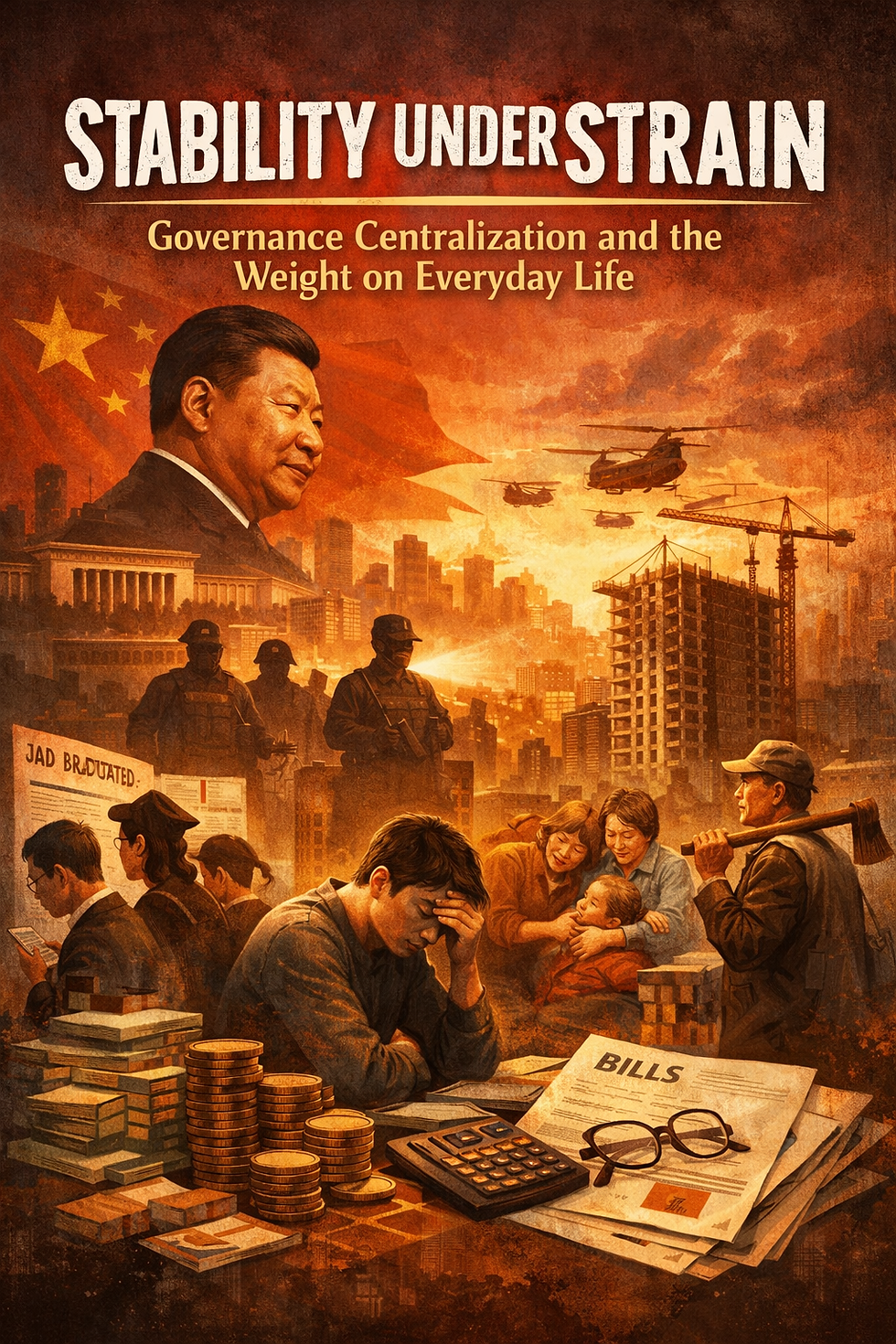
When viewed together, elite-level anti-corruption consolidation and the pressures experienced by ordinary households are not separate phenomena; they exist within the same structural moment. The expansion of anti-corruption into political discipline and systemic risk control signals a governing priority: cohesion, predictability, and centralized authority in the face of economic slowdown, demographic contraction, and geopolitical competition. At the top, this manifests as tightened oversight of officials, financial actors, and military leadership. At the societal level, it corresponds with a climate of caution — in employment decisions, property investment, family planning, and public expression.
For the Chinese people, this does not translate into visible disorder. Infrastructure functions, cities remain modern, and daily life proceeds with material stability. Yet beneath that stability lies sustained compression. Young graduates confront stalled upward mobility. Families navigate property uncertainty tied to generational savings. Households recalibrate budgets as income momentum slows while costs remain high. Cultural expectations surrounding marriage and children collide with financial hesitation. Rural migrants straddle opportunity and exclusion within an uneven system. Meanwhile, speech boundaries shape how frustration is processed and expressed.
The result is not acute crisis but accumulated tension. Economic pressure, demographic anxiety, and constrained public discourse do not erupt outward easily; instead, they circulate inward — within families, within career decisions, within private conversations. Governance consolidation aims to maintain order and regime durability, but it also narrows institutional flexibility at a time when many citizens are adjusting to reduced economic acceleration. The central question is not whether daily life functions — it does — but whether sustained compression can remain socially absorbable over the long term.
In this context, anti-corruption becomes more than an administrative campaign. It is part of a broader architecture designed to secure elite unity and system stability during a period when optimism has softened and expectations are recalibrating. For the Chinese people, the lived reality is one of cautious navigation: balancing duty and aspiration, prudence and ambition, security and constraint. Stability remains intact, but it is stability under pressure — orderly on the surface, complex and weight-bearing beneath.



Comments